
Physical AI: Why Sam Altman and Jensen Huang Say Robots Are Next
On 2 November 2026, at the ADIPEC energy conference in Abu Dhabi, OpenAI chief executive Sam Altman stood beside a deal that had nothing to do with chatbots. Abu Dhabi's state-owned oil company ADNOC had signed an agreement with AI firm G42 and OpenAI to put advanced AI to work across its operations — improving efficiency and tackling complex engineering problems in the oil sector. "For a long time, the AI industry has talked about what it needs from the energy industry. And now I think we can repay the favour," Altman said after the signing. The deal is a sign of where AI goes next: out of the chat window and into the physical world. That shift has a name — physical AI — and the two most powerful voices in the industry, Altman and Nvidia chief executive Jensen Huang, are both betting on it.
What happened in Abu Dhabi
The ADNOC agreement puts OpenAI's technology inside an energy major's daily operations, where the work happens in plants, pipelines and control rooms rather than on screens. This is not a research demo. It is AI deployed where a mistake costs real money, and where the value comes from watching equipment, predicting failures and optimising processes that no chatbot could ever touch. The same pattern is spreading: Shell, Chevron and Foxconn have all struck deals with AI providers in the same push. The ADIPEC deal treats intelligence as infrastructure, not software.
What "physical AI" actually means
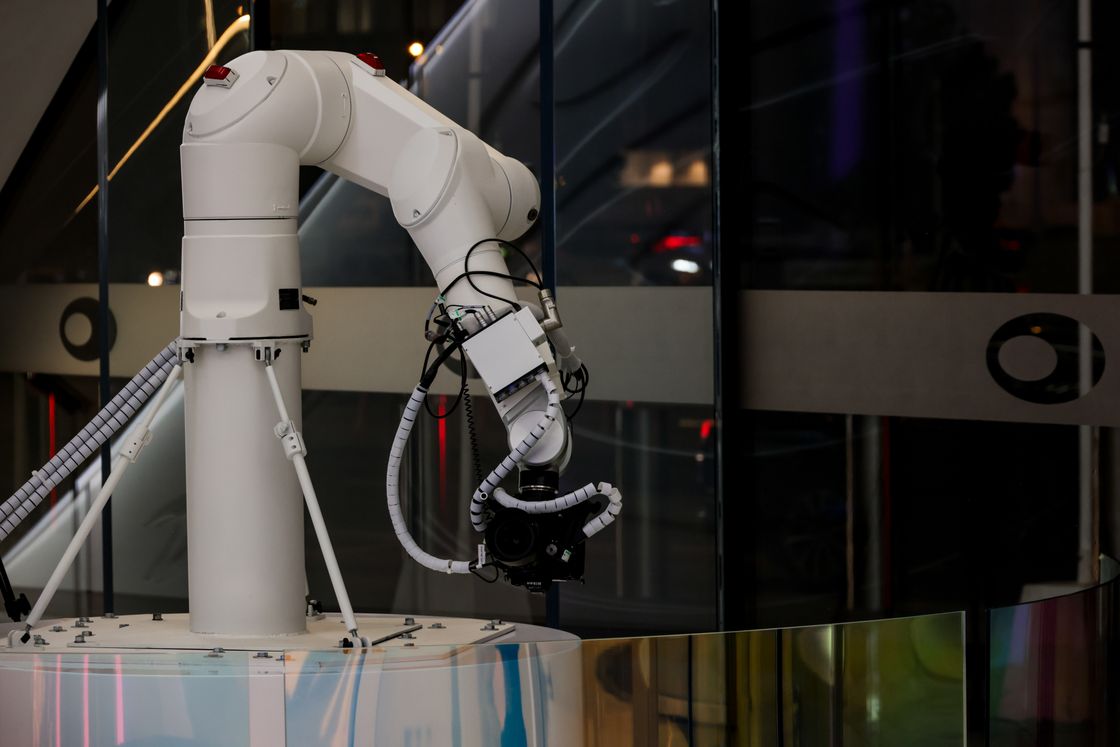
Physical AI is AI that operates in the physical world — robots, camera-bots and self-driving cars that perceive, decide and act in real space, rather than producing text on a screen. A chatbot answers a question. A physical AI system picks up a part, inspects a pipeline, or drives a truck. The difference matters because the physical world does not forgive errors the way a chat window does: a wrong answer in a conversation is embarrassing, a wrong move on a factory floor is expensive. That is why physical AI needs more than a clever model — it needs sensors, cameras, motors and safety systems, all working together in real time. Huang has described the stack as robots built on three computers: one to train the AI, one to simulate the world it will work in, and one inside the machine itself.
Why Huang has been saying this for years
Nvidia's Jensen Huang is widely credited with naming the shift, and he has been framing it as the next big wave of AI for years. In a January 2026 podcast interview he predicted a future with "a billion robots" and a new global economy around building and maintaining them — "nothing short of a second industrial revolution". At Nvidia's GTC 2026 event he put it more plainly: "We have digital agents. Now we have physically embodied agents. We call them robots." He has also called this "the ChatGPT moment for robotics" — the point where robots stop being demonstrations and start being useful. The claim is not that robots are new. It is that the AI inside them finally is: the same kind of model that learned to write can now learn to see, plan and move.
Why energy companies are first
Energy is the natural first stop for physical AI, and the reason runs in both directions. AI data centres consume enormous amounts of power, so the AI industry needs the energy industry. And energy companies own some of the hardest physical problems there are: drilling, refining, power grids, safety monitoring. An AI that watches a plant around the clock, spots a failing pump before it breaks, or optimises a process across a whole refinery is worth far more than a chatbot in an office. That is what the ADNOC deal is buying — not a conversation, but fewer breakdowns and better decisions in a physical plant. The same logic applies to factories, warehouses, farms and roads, which is why the deals are not stopping at oil.
What it means for everyone else
Three things are worth watching. First, work: a billion robots means a new economy of people who build, install, program and maintain them, closer to factories than to software offices. Second, business: AI moves from the screen to the warehouse, the factory floor and the road, which means the companies that benefit are the ones with physical operations, not just the ones with apps. Third, the timeline: physical AI is slower than software. A robot must be tested in the real world, and a mistake in a factory is not a typo you can undo. The chatbot era taught everyone what AI can say. The next era will show what it can do — and the ADIPEC deal is the first big receipt.