
How Instant Payment Soundboxes Process Millions of Transactions Without Dropping a Packet (Webhook Architecture)
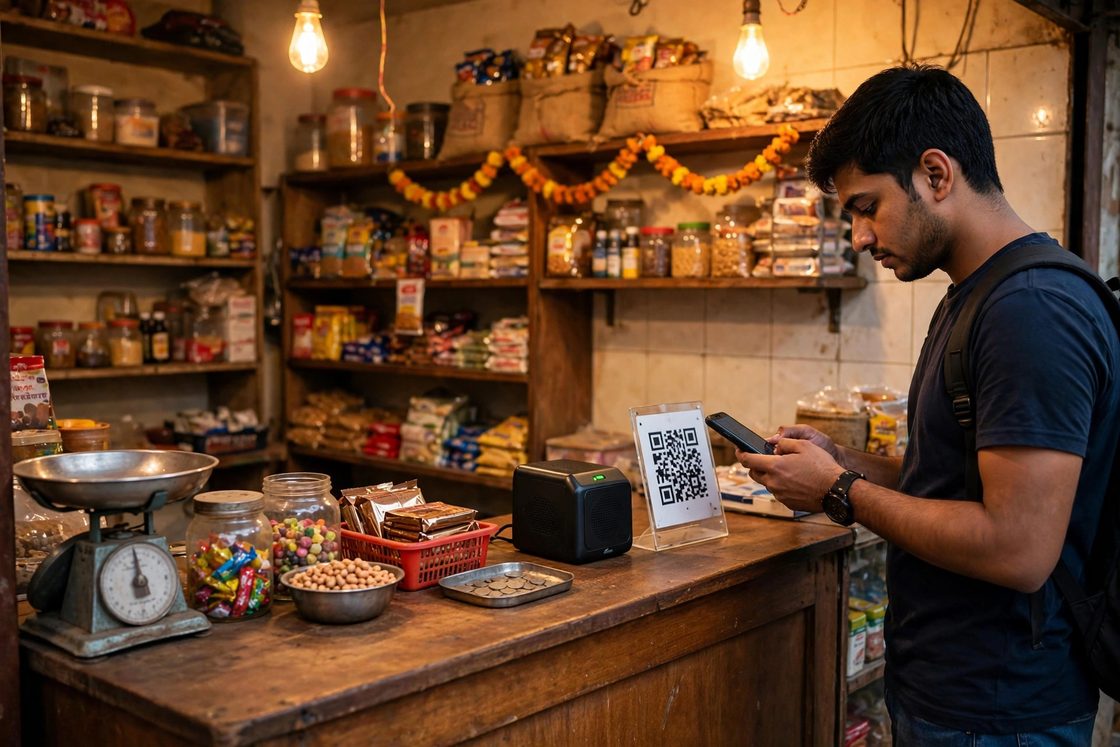
A customer scans the QR code on a shop counter, pays, and before they have put their phone away a small speaker announces the amount out loud. Nobody checks a screen. Nobody asks "did you pay?" The device looks simple — a speaker, a SIM card, a battery — but the real engineering is in the path the payment takes to reach it, and in what happens when any step fails.
This article follows one payment along that path, from the QR scan to the beep. The best-known example is the Paytm Soundbox, which gives merchants instant voice confirmation of QR payments in their own language — but the pattern belongs to the whole category, including PhonePe's SmartSpeaker, BharatPe's speaker and Google Pay's SoundPods.
The scan: a payment starts on the customer's phone
The QR code encodes the merchant's payment address. The customer scans it with any UPI app, confirms with their UPI PIN, and the instruction travels to the customer's bank, then to the merchant's bank through the UPI network. If the money moves, the payment is authorised. None of this involves the soundbox: it is not a payment terminal, never touches the money, and its job starts only after the payment has succeeded.
That separation is the first design decision worth noticing: the box never moves money, so it does not need to be secure enough to. The notification can fail — signal drops, battery dies — without the payment being affected. The money is safe either way; only the announcement is at risk, and the architecture is built to make it catch up.
The webhook: the payment system calls you, not the other way round
Once the payment succeeds, the provider has to tell the merchant's systems. The naive way is polling: the merchant's server asks "any new payments?" every few seconds — fine for one shop, useless for a million, because most answers are "no". The real way is a webhook: the provider POSTs the payment event to a registered URL the moment it happens.
A good webhook endpoint does almost nothing in the request itself: it checks the signature, stores the event, and returns a 200 OK. All the real work happens afterwards, from a queue. If the endpoint tries to do the work inside the request — update the database, send the push, call the device — a slow step makes the provider think the delivery failed, and the provider will send it again.
The signature check is not optional. A webhook endpoint is a public URL, and anyone who finds it can POST fake payment events to it — so every genuine delivery is signed with a shared secret, and the receiver recomputes the hash and compares. The same principle protects WhatsApp webhooks, covered in Real-Time Lead Alerts via WhatsApp Cloud Webhooks.
The idempotency key: the same payment must never count twice
Webhooks are delivered at-least-once, not exactly-once. If the provider does not get its 200 OK in time, it sends the same event again — so the receiver sees some payments twice, and if it processes both copies, the ledger shows the money twice and the soundbox announces the same payment twice. The fix is the idempotency key.
The key is the transaction id itself. Before doing anything with an event, the receiver records its id in a store that enforces uniqueness — a database table with a unique constraint, or a Redis key with a short expiry. If the id is already there, the event is a duplicate: answer 200 and throw it away. The claim must be atomic, because two copies can arrive at the same instant on two different servers.
What this buys: the system no longer needs delivery to be perfect. Duplicates are harmless by construction — a much cheaper guarantee than perfect delivery, which on an unreliable network does not exist.
The queue: absorbing the rush hour
Payments do not arrive evenly. A lunch rush, a festival evening, a market day — the events come in bursts, and the systems behind the webhook cannot always keep up in real time. So between the webhook endpoint and the rest of the system sits a queue. The endpoint writes the event to the queue and returns. Workers take events off the queue and do the slow work: writing the ledger, updating the merchant's balance view, dispatching the announcement to the device.
The queue turns a burst into a line: a hundred events in one second need a queue deep enough to hold them and workers fast enough to drain it. The queue is also the system's memory — if the database goes down for a minute, the events wait instead of being lost. If sending an announcement fails, the worker puts it back with a growing delay, and after a set number of attempts the event goes to a dead-letter queue, where a person can see it. Nothing is silently dropped.
The last hop: reaching a box on a shop counter
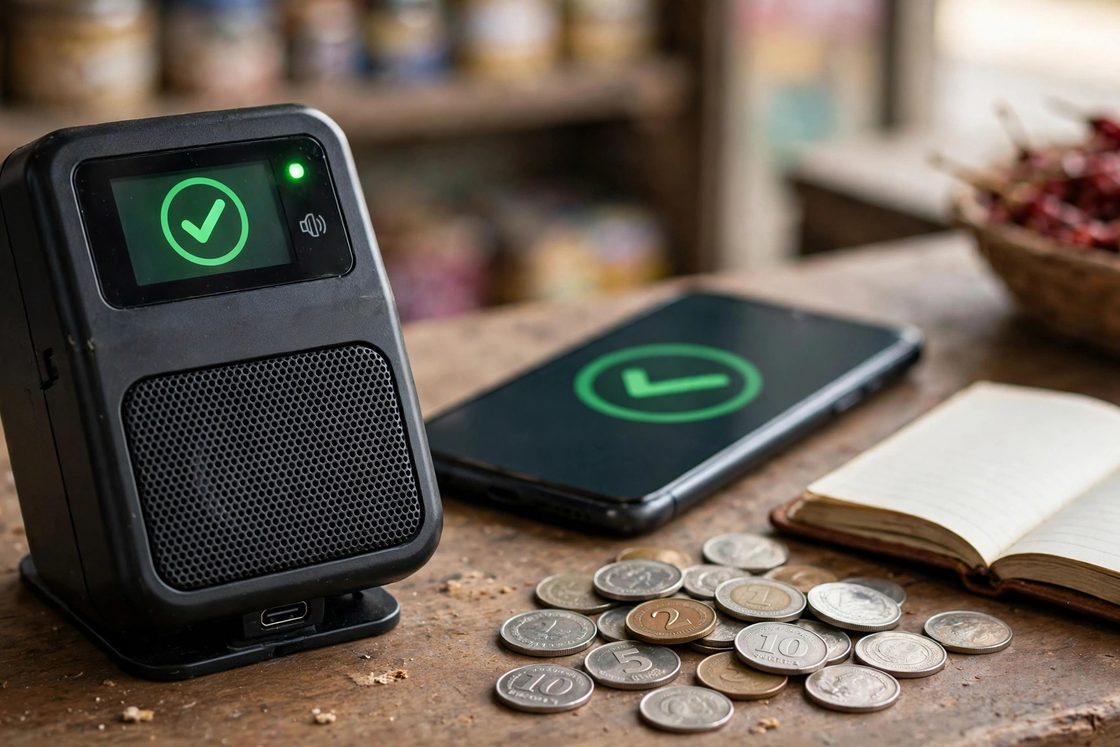
The final hop is the hardest, because the soundbox is not a server. It sits on a counter, runs on a battery, and talks over a mobile network that drops in and out. The cloud cannot call the box directly — it has no public address — so the box keeps a long-lived connection open to the cloud, or checks in on a schedule, and the cloud pushes the announcement down when the box is reachable.
That is why the queue matters all the way to the end. When a box is offline — basement shop, no signal, dead battery — the announcement waits in the queue instead of vanishing, and is delivered oldest-first when the box reconnects. The box stores nothing important, so a stolen or broken box loses no data. And the voice is part of the design: a busy shopkeeper cannot stop to read a phone screen for every payment, and an amount spoken aloud is heard by the customer too.
When things go wrong: the failure-mode table
Every piece of this pipeline has a failure mode, and each one has a designed answer:
| What fails | What the customer sees | What the system does |
|---|---|---|
| Webhook delivery times out | Nothing — payment already succeeded | Provider retries; idempotency key swallows the duplicate |
| Duplicate webhook arrives | Nothing | Transaction id already claimed; event discarded with a 200 |
| Database is down for a minute | Nothing | Events wait in the queue; workers resume when it returns |
| Soundbox has no signal | Merchant hears no beep yet | Announcement stays queued; delivered when the box reconnects |
| Fake webhook is posted | Nothing | Signature check fails; event rejected before any processing |
| Worker crashes mid-processing | Nothing | Event is not acknowledged, so it is retried; idempotency prevents a double count |
Read the middle column again: in every case, the customer sees nothing wrong, because the payment never depended on the notification. The money path is short and heavily guarded; the notification path is long, lossy, and built to recover. Confusing the two is how a small outage becomes a shop full of angry customers.
What this pattern teaches any builder
Any system receiving events from outside faces the same facts: delivery is at-least-once, duplicates arrive, downstream systems fail at the worst moment, and the last hop is the least reliable. The answers are the same at any scale: verify the signature, answer fast, dedupe on a unique id, queue behind the endpoint, retry with backoff, and never let a notification failure look like a payment failure.
What to do next
If your business takes payments, leads, or orders through webhooks — or you want it to — the first step is a short design note: which events arrive, what must never be counted twice, and what happens when the network drops. Start with our Payment Gateway Integration service or our Custom API & Backend Development service, get an instant estimate, or describe the flow on WhatsApp.